IMPLEMENTATION

The Charlotte Future 2040 Policy Map is a companion to the Charlotte Future 2040 Comprehensive Plan and is a translation of the plan’s place-based policies to specific geographies. It informs the type and intensity of development that is appropriate throughout city and will be used in multiple decision-making processes such as future zoning decisions and capital investments. On March 28, 2022 Charlotte City Council adopted the Charlotte Future 2040 Policy Map. Thank you to all who participated and provided your input in this effort!

The first draft was released in October 2021 and the second and third drafts were released in January and February 2022.

On March 28, 2022 Charlotte City Council adopted the Charlotte Future 2040 Policy Map. Thank you to all who participated and provided your input in this effort!
PROCESS AND SCHEDULE

The Charlotte Future 2040 mapping process was developed using a new tool, Place Types, and will followed a 3-step process. 

Place Types

Place Types are a new classification system to organize patterns of development. This tool is more complete and holistic than the city’s previous system called Future Land Use. 

Future Land Use only provides guidance for the type of development (residential, commercial, or institutional) permitted on a property. It occasionally provided guidance for the level of density (low, medium, high) permitted. 

Place Types provide guidance for the mix and proportions of land use, building form and design, mobility, and open space. The Place Type tool was vetted by the community during development of the Charlotte Future 2040 Comprehensive Plan. 

To learn more about Place Types click here or visit Section 02: Complete Communities in the Policy Plan (Vol. 1). 

Also see “Why is Charlotte using Place Types as new classification system to organize development patterns?”

3-step Process

Using the Place Type tool, the Charlotte Future 2040 Policy Map process included 3 primary steps: 

Step 1: Map Existing Place Types – This map translated existing development into Place Types. It helped to illustrate how the new tool is intended to be applied and served as a helpful reference later in the process to assess potential change.

Step 2: Map Adopted Policies Place Types – This map translated adopted area plans (or current land use policies) into Place Types. This illustrated what our community would look like if we did not update the policy map with the Charlotte Future 2040 Comprehensive Plan recommendations.

Step 3: Charlotte Future 2040 Policy Map – The Adopted Policies Place Type Map was revised to reflect the Comprehensive Plan policies such as the Equitable Growth Framework and ensured future growth projections could be accommodated. Revising the Adopted Policies Place Type Map ensured previous community input was not lost while also incorporating the more recent input received during development of the Charlotte Future 2040 Comprehensive Plan.

PAST ENGAGEMENT

To foster engagement, we employed various channels including an online comment map application, virtual one on one listening sessions, virtual community conversations, hard copy materials at local libraries, and email.

Please note that these are past engagement materials and all comment applications were closed at the time of adoption of the map by Charlotte City Council on March 28, 2022.

Use the tabs below to review engagement to date.
Phase 1 Engagement Materials

The following materials were prepared for the first phase of engagement of the Charlotte Future 2040 Policy Map:

CHARLOTTE FUTURE 2040 POLICY MAP & PHASE 1 ENGAGEMENT VIDEO – ENGLISH VERSION
CHARLOTTE FUTURE 2040 POLICY MAP BROCHURE – ENGLISH VERSION
CHARLOTTE FUTURE 2040 POLICY MAP & PHASE 1 ENGAGEMENT VIDEO – SPANISH TRANSLATION
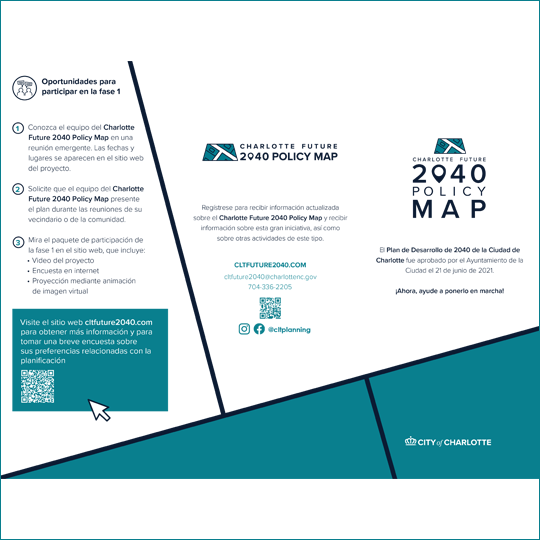
CHARLOTTE FUTURE 2040 POLICY MAP BROCHURE – SPANISH VERSION
Phase 2 Engagement Materials

Charlotte, thank you for your input in helping map our future growth. Meetings were held in October and November to discuss how the DRAFT Charlotte Future 2040 Policy Map and Charlotte Streets Map will inform the future growth, development, and mobility near the places you live, work, and play.

  • The Charlotte Future 2040 Policy Map is a companion to the Charlotte Future 2040 Comprehensive Plan and identifies appropriate locations for future development in our neighborhoods.
  • The Charlotte Streets Map identifies the multimodal vision for Charlotte’s streets to support mobility between the places you live, work, and play.

Due to COVID, the DRAFT Charlotte Future 2040 Policy Map and Charlotte Streets Map was shared with the community in a virtual, two-part meeting series:

First Meeting: October 13, 2021 – Virtual Informational Meeting about the purpose and approach for developing the two DRAFT maps.

Second Meeting(s): October 14 – November 9, 2021 – Virtual Community Conversations to collect public input on the two DRAFT maps in 15 planning areas.

Click to access the presentations prepared for the 15 Community Planning Area Community Conversations.

WATCH THE INFORMATIONAL MEETING HERE:
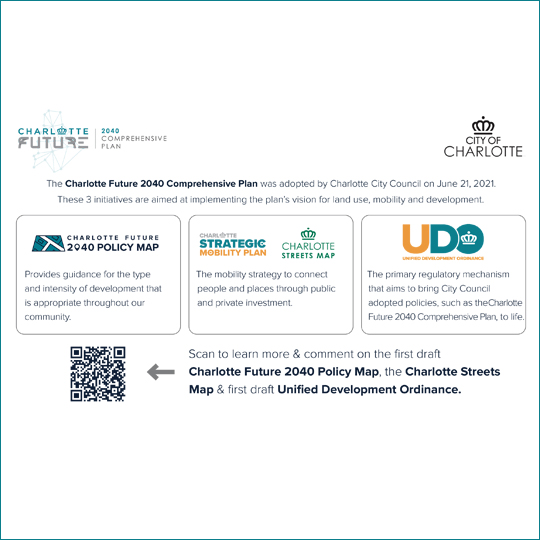
2040 Policy Map, Charlotte Streets Map & the Unified Development Ordinance Handout
WATCH THE COMMUNITY CONVERSATIONS HERE:
Phase 3 Engagement

5 Ways to Engage

The SECOND DRAFT of the Charlotte Future 2040 Policy Map is now available for review. There are multiple ways to participate in this phase of engagement. Due to the current COVID situation, engagement is limited to virtual meetings.

1. Online Comment Map Application: The community can review the revised map and submit comments on the Online Comment Map Application, until Friday, February 4, 2022.

A video explaining how to use the Online Map Application is available in English and Spanish:

English Version
Spanish Version

2. Virtual 30-minute Listening Sessions: From January 25 – 27, 2022 – individual community members, neighborhood groups or organizations had the opportunity to reserve times to meet one on one with staff to discuss the map, ask questions, or address any concerns about the revised map.


3. Virtual Community Conversations: On Tuesday, February 1, 2022 – the community had the opportunity to attend the larger group presentation and conversations offered at 12:00PM and 6:00PM. See below to view recordings of these meetings.

12:00 PM Video
6:00 PM Video

4.  Hardcopies of the second draft map: For those unavailable to attend the virtual meetings, hard copies of the map and feedback forms will be available at the following Charlotte Libraries until Friday, February 4, 2022:

  • Beatties Ford Road Regional, 2412 Beatties Ford Road, Charlotte, NC 28216
  • Hickory Grove, 5935 Hickory Grove Road, Charlotte, NC 28215
  • ImaginOn, 300 East 7th Street, Charlotte, NC 28202
  • Independence Regional, 6000 Conference Drive, Charlotte, NC 28212
  • Morrison Regional, 7015 Morrison Boulevard, Charlotte, NC 28211
  • Mountain Island, 4420 Hoyt Galvin Way, , Charlotte, NC 28214
  • Myers Park, 1361 Queens Road, Charlotte, NC 28207
  • Plaza Midwood, 1623 Central Avenue, Charlotte, NC 28205
  • South Boulevard, 4429 South Boulevard, Charlotte, NC 28209
  • Steele Creek, 13620 Steele Creek Road, Charlotte, NC 28273
  • Sugar Creek, 4045 North Tryon Street, Charlotte, NC 28206
  • University City Regional, 301 E. W.T. Harris Boulevard, Charlotte, NC 28262
  • West Boulevard, 2157 West Boulevard, Charlotte, NC 28208


5.  Email: The community also has the option to send comments or questions about the Charlotte Future 2040 Policy Map to cltfuture2040@charlottenc.gov.

Final Phase 4 Engagement

5 Ways to Engage

The RECOMMENDED FINAL DRAFT of the Charlotte Future 2040 Policy Map is now available for review. There are multiple ways to participate in this phase of engagement. Due to the current COVID situation, engagement is limited to virtual meetings.

1. Online Comment Map Application – The community can review the revised map and submit comments on the Online Comment Map Application, until Monday, March 21, 2022.

2. Virtual 15-minute Listening Sessions – Individual community members, neighborhood groups or organizations can reserve times to meet one-on-one with staff to discuss the map, ask questions, or address any concerns about the final map on Tuesdays and Thursdays from 2:00pm – 4:00pm during this engagement period.

3. Public Comment Session with City Council – On Monday, February 28, 2022, residents can sign up to speak at the City Council’s regularly scheduled meeting . If you have questions or require assistance, please feel free to call the City Clerk’s Office at 704.336.2248 or email: cityclerk@charlottenc.gov.

4. Email – The community can send comments or questions about the RECOMMENDED FINAL DRAFT Charlotte Future 2040 Policy Map to cltfuture2040@charlottenc.gov


5. Hardcopies of the Map – For those unavailable to attend the virtual meetings, hard copies of the maps and comment forms will be available at the following Charlotte Libraries.

  • Beatties Ford Road Regional, 2412 Beatties Ford Road
  • Hickory Grove, 5935 Hickory Grove Road
  • ImaginOn, 300 East 7th Street
  • Independence Regional, 6000 Conference Drive
  • Morrison Regional, 7015 Morrison Boulevard
  • Mountain Island, 4420 Hoyt Galvin Way
  • Myers Park, 1361 Queens Road
  • Plaza Midwood, 1623 Central Avenue
  • South Boulevard, 4429 South Boulevard
  • Steele Creek, 13620 Steele Creek Road
  • Sugar Creek, 4045 North Tryon Street
  • University City Regional, 301 E. W.T. Harris Boulevard
  • West Boulevard, 2157 West Boulevard

On March 7, 2022 and March 14, 2022 Planning Staff presented to the City Council and Transportation and Planning Committee, respectively. Staff provided an overview on the 2040 Policy Map process to date, what we have heard from the community and what are the next steps. See below to view recordings of these meetings.

COMMUNITY BENEFITS

In collaboration with Economic Development and Housing and Neighborhood Services Departments, the Planning, Design and Development Department hosted a Community Benefits Stakeholder Workshop on September 29th, 2021.

Lorem ipsum dolor sit amet, consectetuer adipiscing elit. Aenean commodo ligula eget dolor. Aenean massa. Cum sociis natoque penatibus et magnis dis parturient montes, nascetur ridiculus mus.

Lorem ipsum dolor sit amet, consectetuer adipiscing elit. Aenean commodo ligula eget dolor. Aenean massa. Cum sociis natoque penatibus et magnis dis parturient montes, nascetur ridiculus mus.

ANNUAL REPORT

The Annual Report will be published annually and will inform on progress and implementation of the Plan. It is organized into 3 components:

Our Vision – revisits the vision and goals of the Charlotte Future 2040 Comprehensive Plan;
Our Impact – reports on interdepartmental progress on the Plan’s policy recommendations; and
Our Future – provides a look ahead to upcoming projects.

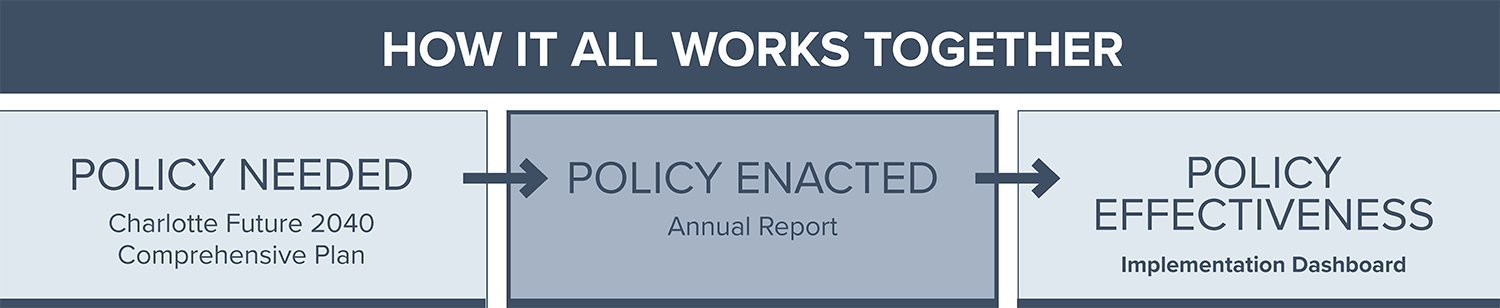
This 2040 Annual Report and the Dashboard will work together to measure the effectiveness of policies enacted based on the Plan.

Download the report:

IMPLEMENTATION DASHBOARD

ABOUT THE DASHBOARD

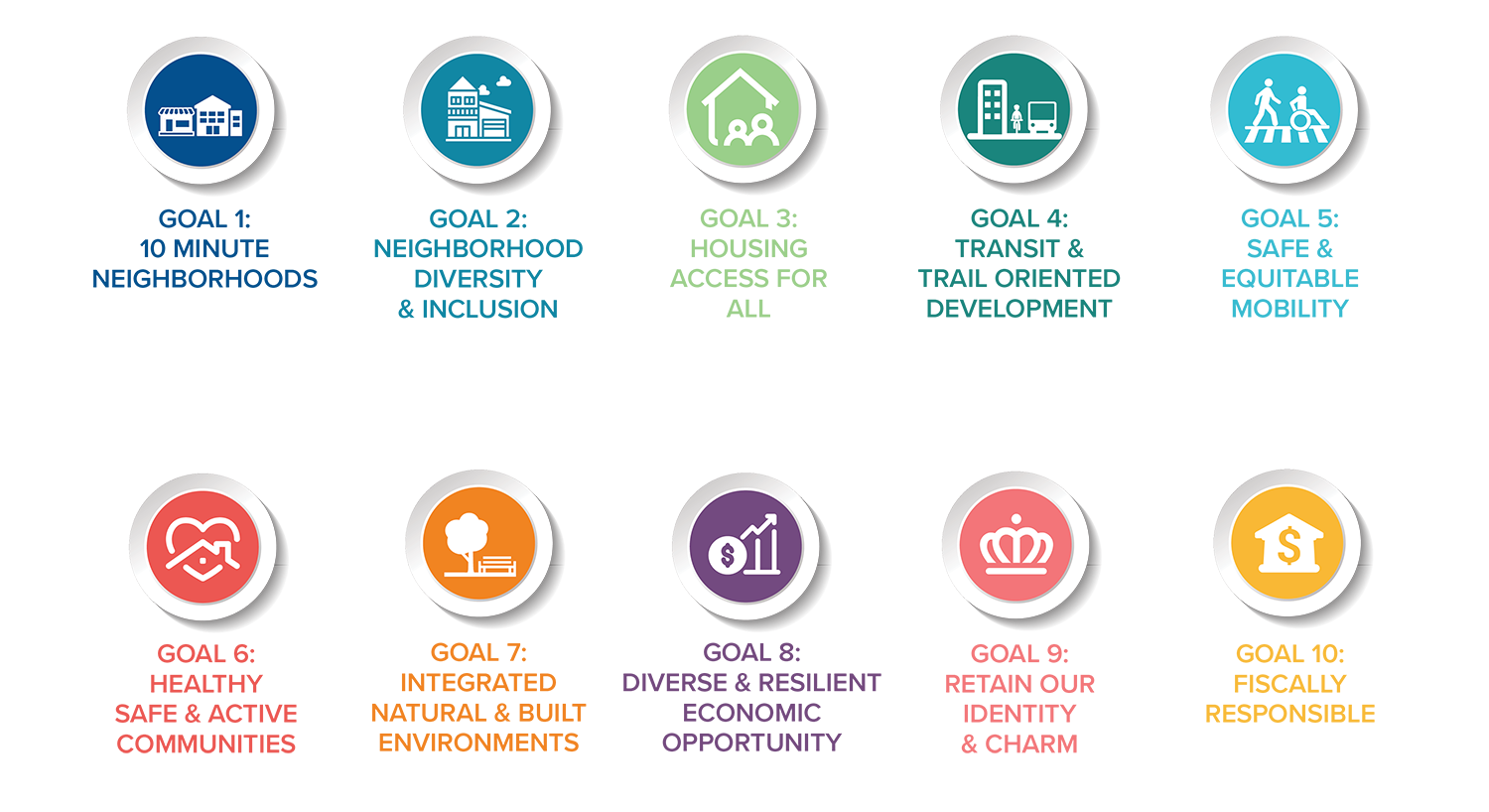
The Charlotte Future 2040 Comprehensive Plan establishes 10 goals with associated objectives and metrics to measure the effectiveness of the Plan and associated policy recommendations.  This dashboard, known as the Charlotte Future 2040 Dashboard, will house those metrics and communicate progress toward implementing the Plan’s 10 goals.


*For the best viewing experience, consider using a laptop or PC. The Dashboard is not optimized for viewing on mobile devices.

This dashboard will work with the Charlotte Future 2040 Annual Report to measure the effectiveness of policies enacted based on the Plan.  The data will highlight areas where we are moving toward achieving the Plan’s goals, or farther away, providing valuable feedback to City staff evaluating updates to the Plan and associated policies.  

This first iteration includes roughly 25% of the data planned for inclusion and will be updated yearly.  The data in the current iteration is based on the City’s managed data and other available data sources.  Over the next four years, data will be added to this dashboard once it becomes available or is created.  The baseline value for each metric will be captured in the year it is added to the dashboard and will be used to determine progress.  Please see the Plan’s listed goals, objectives, and associated metrics here for more information on what is being reviewed for addition in subsequent years.  Once all data metrics are made available, information will be combined to create maps for each of the Plan’s goals, showing the cumulative impact of the Plan.